If you’ve lived in South Orange County for any length of time, you know that our roads aren’t exactly a flat, straight line. Between the steep climbs up towards Wood Canyon and the stop-and-go traffic on Aliso Creek Road, your vehicle’s braking system works harder than you might realize.
When you start hearing a strange noise or feeling a shimmy in the steering wheel, it’s natural to feel a bit of anxiety. Is it safe to drive? How much is this going to cost? At Aliso Viejo Auto Service, we believe that an informed driver is a safer, more confident driver. We want to treat you like a neighbor, because you are one.
Before you search for “brake repair Aliso Viejo” and click the first result, here are 10 essential things you should know to keep your car safe and your wallet happy.
1. That High-Pitched Squeal is Actually a “Feature”
Many people think a squealing noise means their brakes are broken. In reality, most modern brake pads are designed with a tiny metal tab called a “wear indicator.” When your pads get thin: usually down to about 2 or 3 millimeters: this metal tab touches the rotor and makes a high-pitched chirping or squealing sound.
Think of it as a friendly alarm clock for your car. It’s telling you that you still have some life left, but it’s time to schedule a visit for brake repair in Aliso Viejo before things get expensive. If the squealing stops but you haven’t changed the pads, that’s actually a worse sign; it means the metal tab has worn off and you’re moving toward “metal-on-metal” territory.
2. Grinding is the Point of No Return
If that high-pitched squeal turns into a deep, metallic grinding or growling sound, your situation has changed from “maintenance” to “repair.” This sound usually means the friction material on your pads is completely gone, and the metal backing plate is now clawing into your brake rotors.
When this happens, you aren’t just replacing pads anymore; you’re likely looking at brake rotor repairs. Not only is this more expensive, but it’s also a major safety hazard. Your stopping distance increases significantly, and the heat generated can damage other parts of your wheel assembly.

3. Brake Fluid is Your Car’s “Lifeline”
Most people focus on the pads and rotors, but the fluid is what actually makes the system work. Brake fluid is a hydraulic “lifeline” that transfers the pressure from your foot to the brake calipers. Over time, this fluid can absorb moisture from the air, which lowers its boiling point and can cause internal corrosion.
If your brake pedal starts feeling “spongy” or sinks to the floor when you’re waiting at a light on La Paz Road, you might have air or moisture in your lines. We always recommend a fluid check during your vehicle inspections to ensure your “lifeline” is clean and pressurized.
4. Why Aliso Viejo’s Hills Change the Rules
Driving in Aliso Viejo is different than driving in the flatlands of the Midwest. Our hills mean we use our brakes more frequently to control speed on descents. Constant braking generates immense heat. If you’re riding your brakes all the way down a long hill, you can experience “brake fade,” where the brakes temporarily lose their stopping power.
To protect your system, try “engine braking” (shifting to a lower gear) on long descents. If you find yourself doing a lot of hilly driving, you might need general maintenance more often than the manual suggests to keep an eye on heat-related wear.
5. Vibrations are a Sign of Warped Rotors
Have you ever felt your steering wheel or brake pedal vibrate when you’re slowing down from highway speeds on the 73? That’s usually a sign of “warped” rotors. Rotors are the metal discs the pads grip to stop the car. If they get too hot: common in our hilly terrain: they can develop thin spots or uneven surfaces.
You don’t always have to replace them; sometimes they can be “resurfaced” to be flat again. However, if they are too thin, replacement is the only safe option. Ignoring this vibration can lead to suspension services being needed later, as the shaking puts extra stress on your steering components.
6. The “Free Inspection” Trap
You’ll see a lot of shops in Orange County offering “Free Brake Inspections.” While some are honest, many use this as a foot-in-the-door to sell you a full system replacement you might not need.
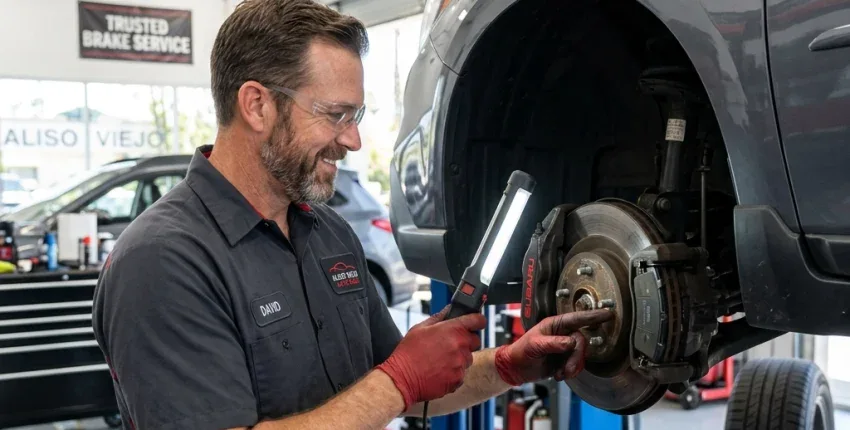
A real, honest inspection should involve taking the wheels off and measuring the pads with a gauge. At Aliso Viejo Auto Service, we pride ourselves on honest communication. If your pads have 50% life left, we’ll tell you that. We’d rather see you in six months for a simple pad swap than sell you something today that you don’t need.

7. Not All Brake Pads are Created Equal
When you get a quote for brake repair, the price can vary wildly depending on the type of pads used.
- Organic: Quiet but wear out fast.
- Semi-Metallic: Great stopping power but can be noisy and dusty.
- Ceramic: Quiet, low dust, and long-lasting: the gold standard for most luxury and daily drivers in Aliso Viejo.
We generally recommend high-quality ceramic or OE-equivalent pads because they handle the heat of our local hills better and keep your wheels cleaner.
8. ASE Certification Matters
Brakes are arguably the most important safety feature on your vehicle. You want to make sure the person working on them knows exactly what they are doing. Always look for a shop with ASE-certified technicians.
This certification means the mechanic has undergone rigorous testing and has the experience to handle complex modern braking systems, including Anti-lock Braking Systems (ABS) and electronic parking brakes. Don’t leave your safety to a “lube tech” who is learning on the job.
9. The Importance of the 3-Year/36,000-Mile Warranty
A shop that stands behind its work is a shop you can trust. Many big-name chains offer a lifetime warranty on the pads, but read the fine print: they often charge high labor rates for the actual installation when those pads wear out again.
We believe in a comprehensive approach. A strong warranty, like a 3-year or 36,000-mile guarantee on parts and labor, shows that the shop is confident in the quality of the parts and the skill of the technician. It gives you peace of mind knowing that if something isn’t right, we’ll fix it.
10. Prevention is Much Cheaper Than Repair
The best way to save money on brake repair in Aliso Viejo is to never let it become a “repair” in the first place. Routine checks during your 30,000-mile service or every time you get an oil change can catch thin pads before they ruin your rotors.
Think of it like dental care: a simple cleaning (inspection/pads) is much cheaper and less painful than a root canal (rotors/calipers/master cylinder). Staying on top of your preventative maintenance is the smartest financial move you can make for your vehicle.

Identifying Problems Before They Get Serious
To help you stay safe, keep this checklist of “Sensory Red Flags” in mind:
- Sound: Squealing, screeching, or grinding.
- Feel: A pulsating pedal, a “spongy” feel, or the car pulling to one side when braking.
- Smell: A sharp, chemical burning smell after a long downhill drive.
- Sight: The brake warning light on your dashboard (don’t ignore this!).
Your Local Partner in Safety
At Aliso Viejo Auto Service, we aren’t just looking to fix cars; we’re looking to build relationships with our neighbors. We know that car repairs can be stressful, which is why we prioritize transparency. We’ll show you exactly what’s going on with your brakes and explain your options without any high-pressure sales tactics.
Whether you’ve noticed a new sound or it’s just been a while since your last check, we’re here to help. Our goal is to get you back on the road safely, so you can drive through Aliso Viejo with total confidence.
Ready for a worry-free drive?
Schedule your brake inspection today and experience the honest, local service you deserve. We’ll make the process simple, fast, and completely stress-free.